Splitting a Fleet: Which Rigs Suit a Hosted Slot and Which Stay Home
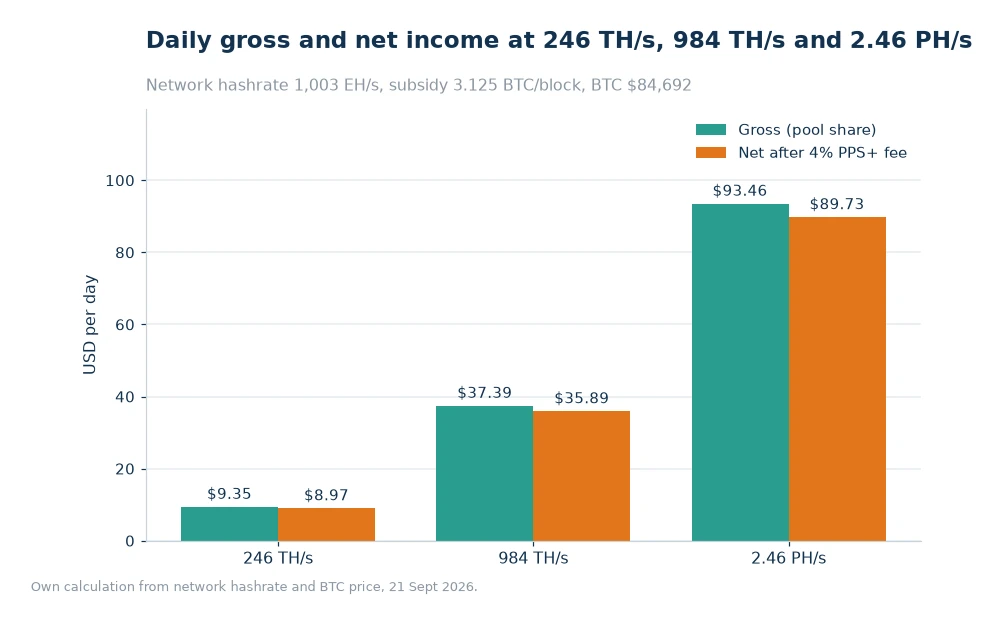
One 246 TH/s unit returns 0.00011036 BTC a day, or $9.35 gross and $8.97 after the listed 4% on the block-reward component at BTC $84,692. Ten of them return $89.73 net. The interesting question is not the total. It is which of those ten should be in a rented hall and which should stay in the room where the power is already paid for.
Key takeaways
- A 246 TH/s unit nets $8.97 a day at $84,692 after the listed 4%; ten units net $89.73.
- Split the fleet by cost per terahash, not by age or by which machine looks newer.
- Hosted slots carry fixed charges per site, so small units gain least from moving.
- Re-test the split whenever difficulty moves or a power tariff changes.
Begin with the roster you have
Most fleet decisions start as a shopping question and turn out to be an inventory question. Before comparing hosting quotes, list every machine with four facts: measured hashrate, wall-plug draw, condition, and the power price where it currently sits. The first two produce the daily net; the third decides how long the unit stays in service; the fourth decides whether moving it is worth the freight.
Do not sort by purchase date. An older unit on cheap industrial power can beat a newer unit on a residential tariff, and a newer unit in a room that is already cooled has a lower marginal cost than its spec sheet suggests. The roster is a set of individual economics, and the split falls out of those numbers rather than out of a rule of thumb.
Three figures per machine
The first figure is the daily credit at the unit's measured hashrate, using the network total of 1,003 EH/s and 450 BTC a day. The second is the daily power cost: wall-plug watts × 24 ÷ 1,000 × the tariff. The third is the fixed cost the unit carries at its current site, divided by the number of machines there. Subtract the second and third from the first, and you have the number that decides whether it travels.
A unit whose margin is thin but positive at home can become negative in a hosted slot, because the slot adds a per-machine charge on top of the same power. A unit with a healthy margin travels well, since the hosted charge is a smaller fraction of its credit. That is the whole logic of the split: the machines with the most headroom absorb a new fixed cost most easily.
Old iron where power is cheap
Efficiency is the ratio that matters. A machine that produces fewer terahashes per watt is more sensitive to the power price, so its natural home is wherever electricity is cheapest and the cooling is already sunk. Sending it to a facility that charges a market rate for power can turn a working machine into a decorative one.
Newer, more efficient units are the opposite. Their margin survives a higher power price, which means they can travel to a site with better uptime and a professional maintenance team. The operator gains reliability on the machines that produce most of the revenue, and keeps the low-margin units where a change in the tariff is the only variable that matters.
The credit does not move with the machine
Pool income follows hashrate and difficulty, so a unit earns the same in either location. What changes is the cost stack: a hosted slot adds rent, power at the site's rate, and whatever the contract says about repairs and minimum terms. The machine's output is fixed by the network; the operator's margin is fixed by the site.
That is why splitting a fleet is a margin exercise rather than a mining exercise. Four units together produce $35.89 net a day at today's numbers, and ten produce $89.73. Whether those totals improve after the move depends entirely on the new cost lines, and on whether the site can keep the machines running through the hours the old site could not.
Freight belongs in the same calculation and is easy to forget. Crating, transport, insurance and a week of commissioning are one-off costs, so each travelling unit should repay them inside a stated period or the move is a hobby rather than a decision. Write the payback window beside every machine. A unit that needs nine months to recover its shipping is a different candidate from one that needs three weeks, even when their daily credits are identical.
Where the travelling units should go
Shortlist from the ViaBTC Mining Companies directory, and read the Miner Hosting entries specifically, since those are the operators set up to take somebody else's hardware rather than fill a hall with their own. Compare the shortlist on the per-machine charge, the power rate and the repair clause, in that order.
Ask each candidate what happens to a unit that underperforms its class, because mixed fleets invite that conversation. A site used to uniform new machines may have no procedure for an older unit that needs a board swap and a longer acceptance test. The answer tells you whether the split will hold or whether the old machines will drift back home within a quarter.
| Fleet group | Daily net | Fixed cost it can absorb | Usual home |
|---|---|---|---|
| Single 246 TH/s unit | $8.97 | Very little beyond power | Own room, existing circuit |
| Four units, 984 TH/s | $35.89 | A modest per-site charge | Either, decided by power price |
| Ten units, 2.46 PH/s | $89.73 | A full-service per-machine rate | Hosted hall with spares |
Worked example
Take one unit, then multiply, and watch how the fixed cost behaves.
- Start with supply: 144 blocks a day at 3.125 BTC each, so 450 BTC daily.
- Over 1,003,000,000 TH/s of network hashrate, one terahash earns 0.00000044865 BTC.
- 246 TH/s × 0.00000044865 = 0.00011036 BTC a day.
- At $84,692: 0.00011036 × 84,692 = $9.35.
- After the listed 4%: 9.35 × 0.96 = $8.97.
- Four units: 4 × 8.97 = $35.89 a day.
- Ten units: 10 × 8.97 = $89.73 a day, or $2,691.90 over 30 days.
- If a hosted slot costs $4 a day per machine all-in, a single unit keeps $4.97 and ten keep $49.73 — the same rate, a very different verdict.
Frequently asked questions
Should the oldest machines move first?
No. Age is a proxy for efficiency, and the decision should use the measured hashrate and wall-plug draw. An old unit on cheap power can have more headroom than a newer one on an expensive tariff.
Is it worth hosting a single machine?
Rarely. At $8.97 net a day for 246 TH/s, a per-machine charge of $4 leaves $4.97, and one repair can erase a month of that margin. Single units usually stay where the room is already paid for.
How often should the split be reviewed?
At every difficulty adjustment and every tariff change, which in practice means quarterly. A split that worked at one power price can invert after a 10% move in either direction.
Write the split down
Produce two lists, one for the room and one for the pallet, each with the daily net and the fixed cost it carries. Sign the date on it. When a hosted unit underperforms, the list shows whether the cause is the site or the machine; when a tariff changes, the list shows which units have to move before the next invoice.
Use the Miner Profitability Ranking to sanity-check each class of hardware against current conditions, and the Mining Farms page when the travelling list needs a destination. The roster is the decision; the listings are only the market it shops in.
Sources: ViaBTC companies, farms and miner ranking pages for listing categories, hosting supply and the listed 4%[1]. Values from 21 Sept 2026: 1.003 ZH/s network hashrate, difficulty 132.76 T, subsidy 3.125 BTC at 144 blocks a day, BTC $84,692. Published 24 Oct 2026; the $4 slot charge is illustrative.