M15 Direct Drive Motors for AGV and AMR Wheel Modules
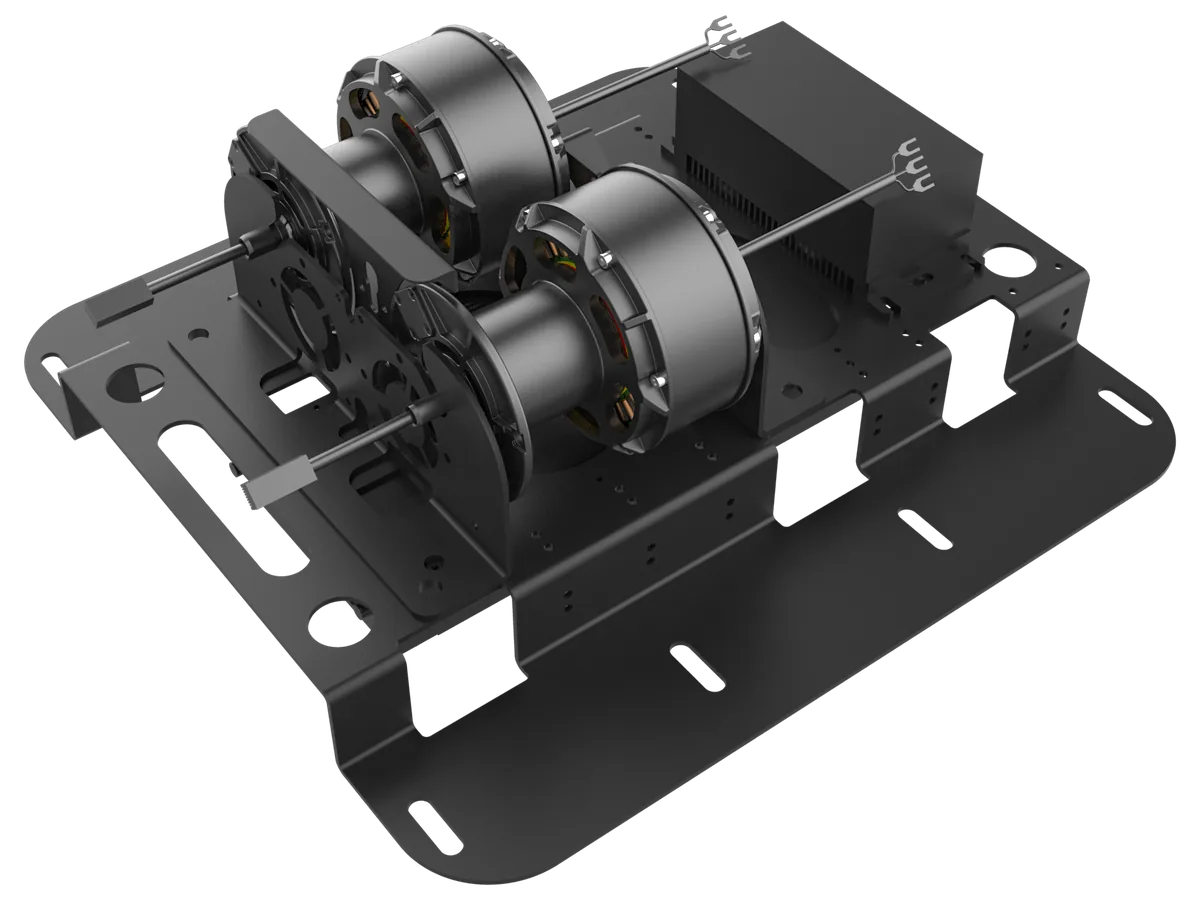
M15 direct drive motors are built for AGV and AMR wheel modules that require compact dimensions, stable torque output, and accurate motion over long operating hours. Modern warehouses often run mobile robots for more than 18–22 hours per day, making transmission efficiency and maintenance intervals as important as peak performance. By removing gear reducers, Direct Drive M15 motors reduce mechanical losses, improve low-speed control, lower operating noise, and simplify wheel module design while supporting applications ranging from automated logistics to semiconductor manufacturing and healthcare automation.
Warehouse automation has expanded rapidly since 2020 as manufacturers and logistics providers increased investments in autonomous transport. Market research from multiple international firms projects annual growth rates above 20% for AGV and AMR deployments through the second half of the decade. That increase places greater attention on wheel modules because every movement, stop, and steering correction begins with the motor.
Instead of transferring torque through gears, Direct Drive M15 motors connect the rotor to the wheel with fewer mechanical transmission components. This reduces backlash while improving repeatability during slow positioning. Robots moving at 0.2–2.5 m/s often spend more time accelerating, stopping, and turning than traveling at maximum speed, making low-speed control more important than top speed.
A direct-drive architecture also reduces the number of wearing components. Gear lubrication schedules, gearbox backlash adjustment, and transmission alignment become less frequent maintenance tasks, helping equipment remain available for longer operating periods.
For engineers selecting wheel modules, motor dimensions influence much more than installation space. Compact motors allow batteries, steering systems, brakes, sensors, and controllers to fit inside smaller chassis designs. Many modern AMRs measure less than 700 mm wide, so every millimeter saved inside the wheel assembly provides more flexibility for system integration.
Performance also depends on torque characteristics across different operating speeds rather than only maximum output. Direct drive technology delivers stable torque from very low RPM, allowing robots carrying loads of 300 kg, 600 kg, or over 1,000 kg to start smoothly without large speed fluctuations. That behavior improves positioning when docking at conveyor stations or automated storage systems.
| Comparison | Gear Drive | Direct Drive |
|---|---|---|
| Transmission parts | Multiple | Fewer |
| Mechanical backlash | Higher | Lower |
| Lubrication | Required | Minimal |
| Noise level | Higher | Lower |
| Maintenance frequency | More frequent | Less frequent |
| Position repeatability | Good | Better |
Lower mechanical friction also contributes to energy efficiency. Depending on gearbox design and operating conditions, transmission losses may reach 10–25%. Removing intermediate reduction stages allows more electrical energy to reach the wheel, helping battery-powered robots complete longer operating cycles before charging. Facilities running fleets of 100 or more mobile robots can see noticeable reductions in total energy consumption over a full year.
Motion quality becomes increasingly important as robots operate near people. Hospitals, pharmaceutical facilities, electronics assembly plants, and laboratories often require low-noise equipment. Direct-drive wheel modules eliminate gear meshing noise, producing smoother acceleration and quieter operation that commonly remains below 60–65 dB under normal working conditions, depending on vehicle configuration.
Encoder feedback also becomes more accurate because there is no gearbox between the motor shaft and the wheel. Motion controllers receive wheel position information with fewer transmission errors, improving path following during repeated transport cycles.
Thermal performance is another consideration during continuous operation. Motors generating excessive heat may reduce efficiency or require cooling measures that increase system size. Modern M15 direct-drive designs typically combine high-fill copper windings, optimized magnetic circuits, and aluminum housings to improve heat dissipation. Surface temperatures remain more stable during repeated duty cycles, particularly in facilities operating 24 hours across multiple shifts.
Several technical specifications should be reviewed before selecting a motor for an AGV or AMR project.
-
Continuous torque rating
-
Peak torque capability
-
Rated voltage
-
Encoder resolution
-
Protection rating (IP level)
-
Maximum radial load
-
Thermal characteristics
-
Communication interface
-
Wheel diameter compatibility
Additional information about the Direct Drive M15 motors series can help engineers compare available configurations for different wheel module designs.
Industrial environments also differ considerably. Cold-storage warehouses may operate below -20°C, while manufacturing facilities can exceed 40°C. Dust, moisture, cleaning chemicals, and continuous vibration all influence motor selection. Protection ratings such as IP65 or IP67 help reduce the chance of contaminants reaching internal components during long service intervals.
As mobile automation expands into distribution centers, airports, hospitals, food processing plants, and semiconductor factories, wheel modules continue to become smaller while carrying heavier loads. Manufacturers increasingly combine steering motors, drive motors, brakes, sensors, and communication electronics inside integrated assemblies that simplify installation and replacement. Direct-drive technology fits well within this approach because fewer transmission components leave additional space for electronics while reducing routine maintenance throughout the equipment lifecycle.