Comparing Adult AI Chat to Other Hobbies: Time and Money
Any hobby is a bargain or a burden depending on what it returns per hour, and the useful comparison is between habits rather than between products. Adult AI chat asks for minutes that are usually already free - late evenings, quiet mornings, commutes - and gives back conversation that is available on demand. Estimating your own hours first, then comparing, is the only comparison that means anything.

Key takeaways
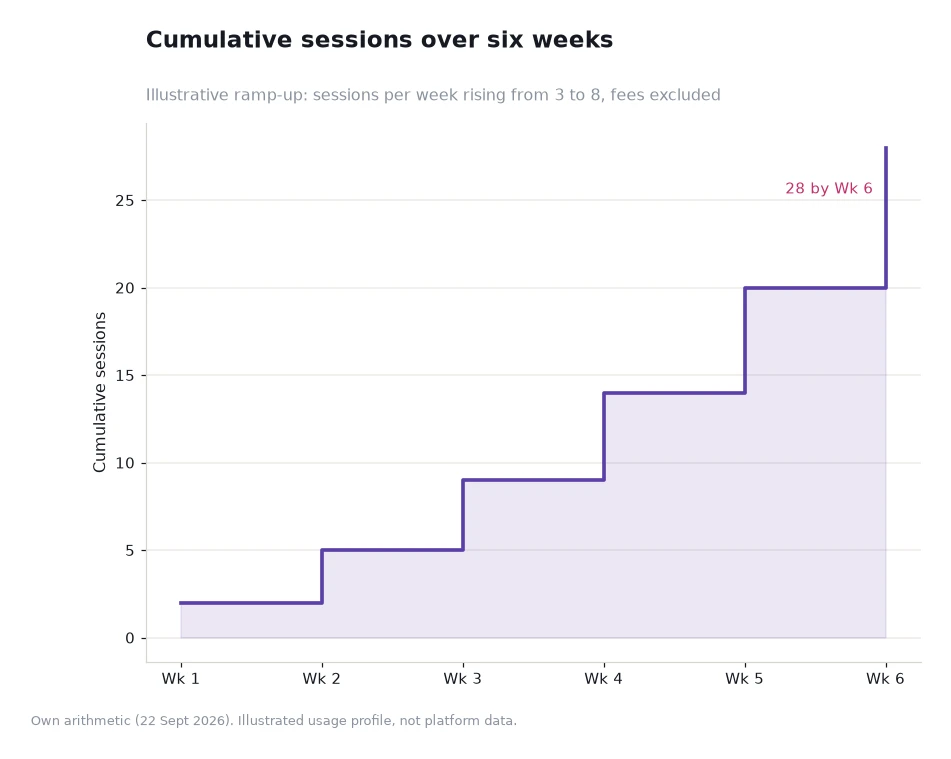
- Compare in hours: a six-week ramp of 28 sessions at 15 minutes each is 420 minutes, or seven hours.
- Setup cost matters as much as running cost - most hobbies need equipment, travel or an appointment before they begin.
- On-demand access removes scheduling friction, which is what makes a fifteen-minute window usable at all.
- Judge the habit by what it returns per hour: variety, progression and predictability, in that order.
Two currencies, and only one of them is money
Money is the currency people compare first and it is the least informative, partly because it varies by region and offer and partly because it says nothing about what you get. Hours are the better denominator: they capture whether a hobby fits your week, whether it needs planning, and whether you can start it at short notice.
Run the comparison on both. A hobby that costs little and demands an hour of travel each time is expensive in a different currency, and one that costs more but begins the moment you sit down is cheaper than its amount suggests. Adult AI chat sits at the far end of that spectrum: nothing to travel to and nothing to set up.
Friction is the second axis worth measuring. A hobby with high friction gets done on weekends; a hobby with none gets done whenever a free half hour appears. Since most leisure time is fragmented, low friction is worth more than it looks.
There is a cost to that, and it is worth naming. Hobbies with appointments force a rhythm and provide company, which is a return that on-demand leisure cannot reproduce. A chat habit is solitary and unforced, so its value depends entirely on whether the conversation itself is good; nothing else is holding the habit up. That is an argument for choosing characters carefully rather than an argument against the format.
Progression is the part most readers underestimate. A saved shortlist, a thread that has run for a month, notes that describe what you want: together these form a record of the habit that other leisure activities get from scores or equipment. Keeping them is what makes a chat habit feel like it is going somewhere rather than merely passing an evening.
Estimating your own hours
Take a session ramp that most new habits follow, an illustrative one: 2 cumulative sessions after week one, then 5, 9, 14, 20 and 28 by the end of week six. The weekly additions are 2, 3, 4, 5, 6 and 8, so the pace quadruples over six weeks while the total reaches 28 sessions.
Convert to time at an illustrative 15 minutes a session. Six weeks then contain 420 minutes, which is seven hours, or about 70 minutes a week. That is a modest habit by any standard: a little over an hour a week is less than a single episode of most series and considerably less than a weekly sports fixture with travel.
Then annualise it for perspective. Seventy minutes a week across a year is about 61 hours. That is a real commitment and a manageable one, and it makes the comparison concrete: the question is not whether the hours add up, but whether 61 hours a year is what you want to spend them on.
| Dimension | Chat habit | Typical other hobby |
|---|---|---|
| Start-up friction | None, begins when you open a thread | Equipment, travel or booking |
| Session length | 10 to 30 minutes comfortably | Often one hour minimum |
| Scheduling | Whenever a window appears | Fixed slots, other people involved |
| Progress tracking | Thread history and saved characters | Levels, scores, distances |
| Variety | Large catalogue, chosen by query | Fixed once equipment is bought |
Read the table as a set of trade-offs rather than a scoreboard. The advantages of low friction are real, and they come with the absence of the social and physical dimensions that make other hobbies worth their cost.
Worked example: hours against hours
Put the chat habit beside a physical hobby that needs a ninety-minute round trip before the activity even starts. Two outings a week at 90 minutes of travel plus 60 minutes of activity is 300 minutes a week; the chat habit measured above is 70 minutes a week, or about 23 percent of the same budget. Over six weeks, that is 1,800 minutes against 420.
Now express the chat side monthly: 420 minutes across six weeks is 70 minutes a week, or roughly 300 minutes a month, five hours. A hobby that occupies five hours a month is easy to hold but easy to neglect, which is why the third measure in the table matters: if a habit cannot be tracked, it quietly stops happening.
Tracking is where the platform's own signals help. Saved characters act as a record of what you returned to, and the counters behind the catalogue give context for scale: a card with 24.3M views and 7.1K favourites converts at roughly 0.029%, which is a reminder that popularity is broad and preference is narrow. Your five hours a month are better spent inside that narrow band, on two or three characters you actually return to.
What a hobby owes you
Three returns decide whether any leisure habit lasts. Variety keeps it from becoming routine; progression gives the time somewhere to go; predictability means you know what a session will be before you start. Chat formats are unusually strong on the third and dependent on you for the other two, which is the honest argument for spending a few minutes choosing well.
Choosing well is a query, not a mood. The platform's own description of https://crushon.ai/ai-porn-chat, which it presents under the heading Porn Chat AI, sets out how the format is meant to work, and a shortlist built through the character search turns five hours a month into three or four conversations you actually chose.
Compare the habit with the alternatives by the hour, decide what the hour is worth, and revisit the answer once a season. That is the whole method, and it applies to any hobby in the list.
Frequently asked questions
Is a chat habit cheaper than other hobbies?
It has much lower running friction, which is the part that usually decides whether a hobby survives. This article deliberately compares time rather than amounts, so no figures are quoted.
How many hours a month is typical?
On the illustrative ramp used here, about five hours a month, or 70 minutes a week. Light and heavy habits sit on either side of that.
What is the strongest argument for the format?
Availability. A fifteen-minute window can become a session, where most hobbies need an hour and some planning before anything begins.
Count the hours before you judge the habit
Log two weeks of sessions, add the minutes, and compare the total against what the alternatives ask of your week. If the answer is five hours a month that you chose deliberately, the comparison is settled. The readers this piece is aimed at are adults of 18 and over.
Sources: the trending counters behind the 0.029% ratio and the feature wording quoted above were read from Crushon on 22 Sept 2026. The six-week session ramp, the session length and the 90-minute comparison hobby are illustrative assumptions rather than measured data, and this article quotes no prices.[1]